Julian Opie, Joggers. 5. Colored.
https://www.julianopie.com/film/2015/joggers-5-coloured-0
2015, Continuous Computer Animation on 22″ LCD screen

When creating his series of runners, Opie thought about “striding athletes circling ancient Greek vases, and of stone-carved Roman friezes of battling warriors.” He saw the sports equipment and technological accessories comparable to old armor. He wished to capture the dynamics and movement, along with the theory that man was made to run. Making a stride appear in 30 frames, Opie can put the animated man on a run forever, and as each character runs the composition evolves and re-evolves.
Theo Triantafyllidis, Prometheus, 2017
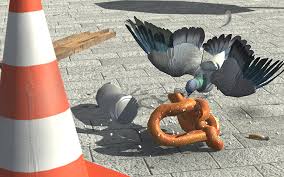
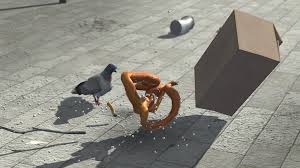
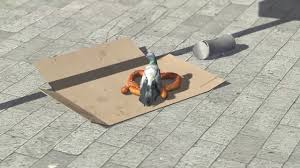
FIAC PROJECT
Live simulation screen work on custom setup
Theo Triantafyllidis, born in Athens, Greece, has created an animated work in live simulation that comments on the absurdity of human behavior. The pigeon in this video represents the human, and displayed on an endless loop cycle is the greed and egocentrics of our species as we attempt to capture and consume a pretzel which keeps fleeing. This simulation, similar to Emissaries is constantly evolving on random variables and based on a computer archiving algorithm and gives a physical presence to digital information.
Paul Chan- The 7 Lights
Exhibited first with The Serpentine Galleries in UK
New York Based artist, focusing around themes of politics, poetry, war, death, and desire, this exhibition combines light projection over walls and floors snd silhouette artistry. Viewers witness silhouettes rise and fall in the massively lit surfaces, along with a selection of 2D art as well. The title can relate to the biblical tale of the origin of the world and its impending end.
.
1st Light, 2005
Digital video projection, 14 minutes
Courtesy of The Dakis Joannou Collection, Athens
Courtesy of Greene Naftali Gallery, New York

Kara Walker- 8 Possible Beginnings or: The Creation of African-America

MATERIALS
16mm film and video transferred to DVD (black and white, sound), boxed with paper silhouette
Duration: 15min, 59sec
Kara Walker, known for her powerful imagery comprised of simplistic black silhouettes from paper cut-outs, composes scenes of oppression, violence, and sexual acts in the context of the history of the slave trade in America.
The film is comprised of 8 scenes wrought with satire, in which Walker narrates a rather mythical establishment of slavery in the history of the United States. First their is the voyage across the Atlantic, and then we witness the consumption and defecation of the black people, and of the defecation rises a young black slave. He then mates with his master, King Cotton, and the spawn of their sexual relationship is the crop of cotton.
Walker uses her cut out technique and silhouettes in puppetry form for this short film. Doing such allows her to address topics so grotesque such as rape of slaves by their masters, lynching, and the history of slavery as a whole in a way which feels child-like, like a fairytale. There is also reference to an Uncle Remus. Walker took inspiration from the Walt Disney Animation, Song of the South (1946), based on Uncle Remus, a character from the stories of American novelist Joel Chandler Harris.
Fantasmagorie
Fantasmagorie, made in 1908 by Émile Cohl, is considered one of the first examples of hand-drawn animation. The animation contains different scenes, sequences of stills taken on negative film, of a stick-figure man interacting with his morphing environment. At certain points, for example at the start of the film, there are moments of live-action when the artist puts his hand into the scene. The main character interacts with a character of a woman with a large hat and a clown who pops out of that hat. There is also transforming objects, such as a wine bottle to a flower and then to an elephant.
Cohl was part of the Incoherent movement, started in the late nineteenth century by French author and publisher Jules Levy. The movement was founded on a tone of sattire, a sort of radical, rebellious redefining of art. For example, for their first exhibition Levy intended to make an exhibition for “an exhibition of drawings made by people who can not draw.”
William Kentridge
William Kentridge, born April 28th 1955, is a South African artist who is renowned for his drawings and animations. Kentridge towards the end of the 1990s and early 2000s constructs animations by drawing a scene, erasing some of it, and re-drawing. This process combined with a meticulously timed film sequence, succeeds in demonstrating animation in the context of art in a very effective way. As a resolution to the process these animations are exhibited with drawings as well.
https://www.tate.org.uk/art/artists/william-kentridge-2680
William Kentridge, 1966 History of the Main Complaint,
Film, 35 mm, shown as video, projection, black and white, and sound (mono)
Kentridge constructed this film by making 21 repeated sequenced filmed drawings with charcoal, pencil, and pastel on paper. After each erasure parts of the process still produce themselves, with memory serving as a motif. This piece is a part of a series titled Drawings for Projection. The series focuses on the battered post industrial landscape of the Johannesburg area. This film, 6th in the series, depicts property developer and capitalist Soho Eckstein in a coma on a hospital bed. Music and sounds of reminiscence to Soho’s life begin playing in the background as we follow the narrative of a person being hit and killed by Soho’s car, and at that exact moment he awakes. The animation concludes with Soho in his office, back to his normal life- an open-ending as to whether this hospital visit or eureka moment has changed him and his greedy actions. The message of Kentridge’s short is white power and white responsibility.
Links to paper and presentation
Ian Cheng Emissaries
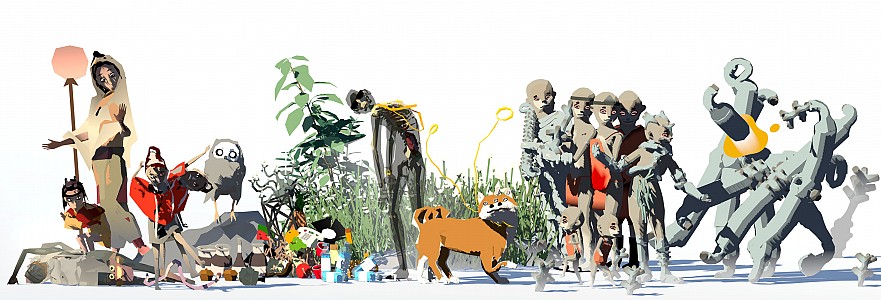
The narrative agents and wildlife of Emissaries, Ian Cheng, 2015-2017
“Emissaries is a trilogy of simulations about cognitive evolution, past and future, and the ecological conditions that shape it. It is composed of three interconnected episodes, each centered on the life of an emissary who is caught between unraveling old realities and emerging weird ones.”
Ian Cheng is know for creating amazing lives simulations, which combine predetermined factors as well as some undetermined. Cheng sees his simulations as mimicry to the systems of livelihood, and that these narrative and yet non-narrative works represent a certain opportunity to incredible possibility.

Ian Cheng, Emissary Squat of Gods, 2015
Observing an ancient community on the brink of extinction by volcanic eruption, Cheng has created a simulation in which all characters are acting on predetermined behavior, based on algorithmic actions, except for a singular character- that of a child in the narrative, who interacts radically with that around her.

Ian Cheng, Emissary Forks at Perfection, 2015-2016
Post volcanic eruption, a post-mortem organism given the name Al finds a human body. He sends his dog- who does not have predetermined conscience, to look further.

Ian Cheng, Emissary Sunsets the Self, 2017
At the end of Al’s existence he transforms into a wave. Now Al is the emissary as he interacts with the inorganic forms around her. Another civilization comes into the picture as they attempt to control wave Al and limit his deviation.
Lake Valley


Lake Valley, an animated film by American artist Rachel Rose, combines collage and a unique video format to present a spectacular journey through a dreamlike, utterly imagined world. The video follows a rather ambiguous-formed pet, whether it be a bunny or a dog… from the boring restraints of life in a New York suburb to the phantasm of the night. The viewer finds itself peering into a world of luscious, psychedelic forests, full of fairylike sounds and hypnotizing beats, as the video floats from dream scene to dream scene. Rose used a method of collaging illustrations from 19th century children’s books with digital animation, to visually present the nostalgia and melancholy of a childhood imagination against the boredom of the real world.
 Art, Media, and Technology curatorial project